
The Hills are Alive
... to the sound of ...


Dia dhaoibh a chairde
It’s been an unusually intense season for the cicadas (pronounced ‘secators’ to my ears) in Wellington this year and the hills around the city are alive and ringing with a background static so vivid it makes your head spin. It’s particularly loud when you venture into the deeper sections of bush, but even as I’m writing this, I can hear the sound piercing the window. A sequential series of warm summers and mild winters have accelerated their development in recent years, leading to larger, synchronized populations and making this summer particularly noisy.
If you don’t know what a cicada is - I didn’t when I first came here - they’re a kind of large, winged insect most famous for the loud, buzzing-based mating calls made by males during warm weather. It looks like this.

When I first came to New Zealand, it was high summer at the time, and I was absolutely blown away by the sound. We had crickets at home of course, which produced a similar kind of buzzing, but it seemed to be far less intense than the local variety. During my first week in Wellington, I asked one of my friends what was making the noise and he told me it was “The cicadas”.
As above, however, what I actually heard was “Desiccators”, which meant that for the next twelve years or so. I’d tell everybody how amazing I found the sound of desiccators. Finally, in twenty-fifteen or so, when I was telling my kids how much I enjoyed listening to the desiccators, they looked at me in bewilderment and asked what I was on about. That’s when the truth finally came out. It still astounds me that I was working to such a huge misassumption for such a long period. It seems even more astounding that nobody ever pointed out my error before then.
Perhaps they thought it was my accent.
Work In Development
No updates that I’m willing to share this month. I’m continuing to work my way through “Liath Luachra: The Quiet One” but I’m at that chaotic point where a number of different plot and character threads need to merge so I’m specifically focussed on that for the moment.
I’ll be well at a point where I can provide more detail in next month’s newsletter.

Changes to the Newsletter
Recent changes on the family and professional level have meant that, going forward, I’ll be operating a different model for the newsletter. From next month onward therefore, the following will come into effect:
(1) Going forward, the free portion of the newsletter will focus uniquely on my writing, my books, and other projects. All cultural, mythological, and non book-related cultural creative elements, will get pushed behind the paywall.
Part of the reason for this, is that a number of ‘followers’ have been using content from my newsletter as input to their own newsletters/social media posts. More importantly however, anything outside the protection of a paywall is immediately scraped and uploaded as input to AI models from Facebook, Amazon, Google, Microsoft etc. etc.
In effect, that means that any original content produced by independents like myself, via blogs, newsletters, and other mechanisms, is now automatically appropriated by the large (and unregulated) IT giants. Because these IT giants are not subject to any laws in their own jurisdictions, they can essentially pirate anybody’s work and use it without consequence.
Obviously, that’s not a sustainable, long-term model and going forward, I may finish up the free plan or move to another platform. I suspect we’ll be seeing a lot of other creators doing some variation on this as time goes on.
(2) The monthly plan price for the newsletter will be dropping to $5/month (the minimum). The annual plan price will be dropping to $40 /year.
Both plans will provide regular early access to my fiction work as well as increased access to articles on Irish culture, ‘mythology’, and other creative elements.
Annual plan members will also receive free, early access copies of each fiction ebook as its released (and probably some audio).
Báite [Drowned]
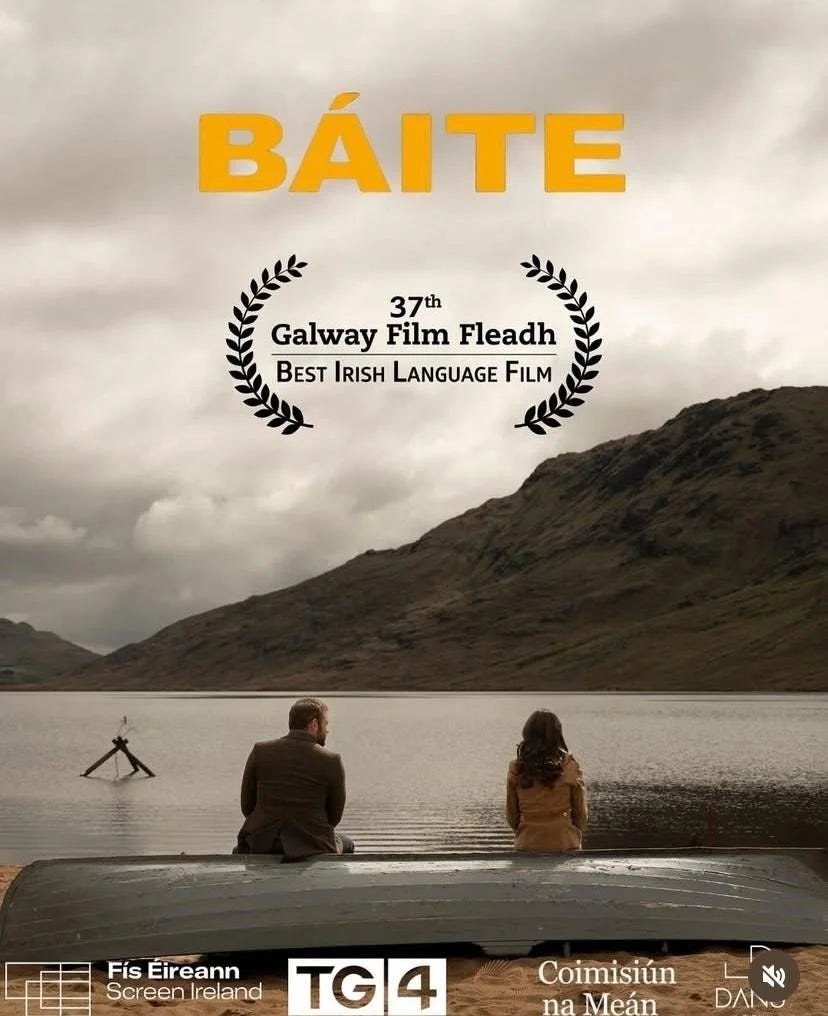
If you’re not aware, there’s a new Irish-language feature film being released in Ireland on the 6th of March. Titled ‘Báite’ (The Drowned), it’s a murder mystery set in 1975 rural Ireland, and it tells the story of a woman trying to save her family pub when the discovery of a body in a drying lake (during a drought) exposes some dark secrets in the community.
Presumably, about heavy drinkers.
The film’s produced by Danú Media (a bilingual Irish screen production company based in Spiddal, Co. Galway). I think this is their first major feature although a few years back, they also acted as producers for a film called ‘A Date for Mad Mary’, which I really thought was quite good.
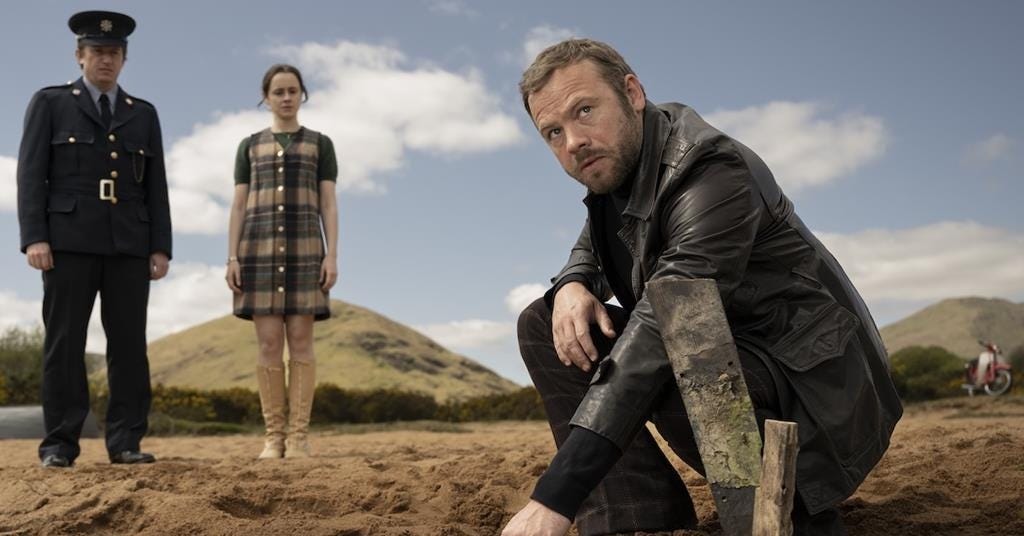
I haven’t seen the movie as yet, but the initial reviews describe it as ‘watchable’, if a bit ‘neat’ in terms of plot resolution. It does contain some interesting plot elements however, such as a man-made lake that covers the remnants of an old village and its cemetery – something key to the overall plot. That trope’s been done a few times before, but it’ll be interesting to see their take on it.
The film is directed by Ruan Magan and was shot entirely in Connemara. It stars Eleanor O’Brien and Moe Dunford, the 2015 novel – The Lake – by Sheena Lambert.
Here’s the trailer:
Just for interest’s sake, I’m also adding in the trailer for the 2016 film ‘A Date for Mad Mary’, mentioned above. This a gritty kind of Irish rom-com-drama about "Mad" Mary McArdle who’s just been released from prison to learn her best friend, Charlene, is getting married.
Determined to prove she can find a date to be her maid of honour's "plus one", Mary embarks on a series of awkward, failed dates before developing an unexpected connection.
Procurator
I’ve just finished Procurator by author Kirk Mitchell, an American writer I was unfamiliar with but who was quite prolific between the 80’s and the 00’s. Although mostly renowned for his time travel, alternate history, and adventure novels, he was also hired for literary novelizations of several movies ranging from Lethal Weapon (the 1987 Mel Gibson vehicle) to Colours (1988) and Mississippi Burning (1989) among many others.
Procurator is the first book in his Germanicus trilogy, a collection of books that follows the adventures of Germanicus Agricola in an alternate history where Rome never fell, Christianity never caught on, and Christ apparently just dropped out of sight. The series consists of:
Procurator (novel) (1984)
The New Barbarians (1986)
Cry Republic (1989)
I have to admit, I bought the set last month as I was intrigued by the cover to Procurator which features a strange kind of Roman galley/Tank on the front cover. That cover also encapsulated the genre of the story which is an ambitious alternate-history adventure based around the concept of what would happen if the Roman Empire never actually fell?
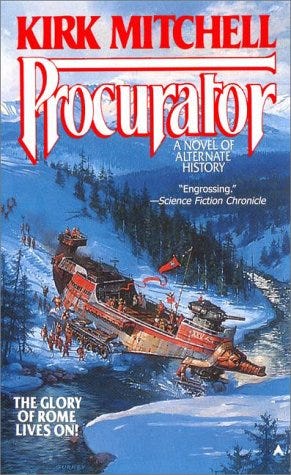
Using this premise, Mitchell goes on to investigate a sprawling tale of political intrigue, battlefield drama, and conflicting cultures played out in in a twentieth-century Roman world that’s eerily familiar but also confusingly different at the same time. In Procurator, Rome rules Europe, North Africa, and much of the Middle East and have also managed to make it to America/Canada. Despite this, their tech seems very much confined to the clunky, steam-driven tech of the early 19th century.
The protagonist, Germanicus Agricola, is an aging and near-to-retirement procurator (governor) of Anatolia (modern day Turkey) who ends up trying to quell a potential uprising from the local indigenous people and their ‘Zaims’ – an odd combination kind of druid/magician. These individuals are believed responsible for killing Roman soldiers through ‘massing’ – an undefined mystical process. To add to his troubles, Germanicus must also lead the defence of key Roman infrastructure against attacks from rebels and militants stirred up by the zaims. In this, he’s ably assisted by his companions, the beautiful Scandian Colonel Crispa and the intense Colonel Marcellus.
What Germanicus doesn’t know, unfortunately, is that Crispa and Marcellus are involved in a plot against him and the Roman Emperor, a threat further complicated because of the love triangle between them.
Is it any good?
Well, I enjoyed it. It’s by no means the best novel I’ve ever read and, because it was originally published in 1984, certain depictions of cultural and religious groups and certain plot elements may feel a bit dated. That said, as genre material goes, it’s certainly readable and the pages turn without effort.
To be honest, I found the first two chapters a little confusing as I tried to adapt to some inadequately explained elements of a new world (in particular, trying to work out/visualise what ‘sand-galleys’ were). After that, however, the story flowed along quite easily, and the work was different enough to retain my interest.
Mitchell’s worldbuilding is very good and it’s obvious that he has a firm grasp of Roman military and governance structures. He also incorporates the cultural tensions (including the usual racism of occupying forces) associated with managing an empire across different continents into the story in an effective manner.
The End
That’s all for February 2026. The paid section continues with the next section of Beara: Cry of the Banshee and part of an article entitled ‘The Mystery of the Magic Snail’ dealing with the remnants of old animal rituals that we used back in the day.
I’ll be back at the end of March with more detail on upcoming works.
Until then …
Slán go fóill!
Brian

